The Emperor: Boundaries or Tyranny?

When the Emperor appears in a tarot spread, most readers will instantly think of authority, stability, and structure. He is the father figure of the deck, the one who sets rules and enforces order. Upright, he can represent wisdom, protection, and the security that comes from boundaries. But reversed, he becomes something else entirely: rigidity, control, and oppression.
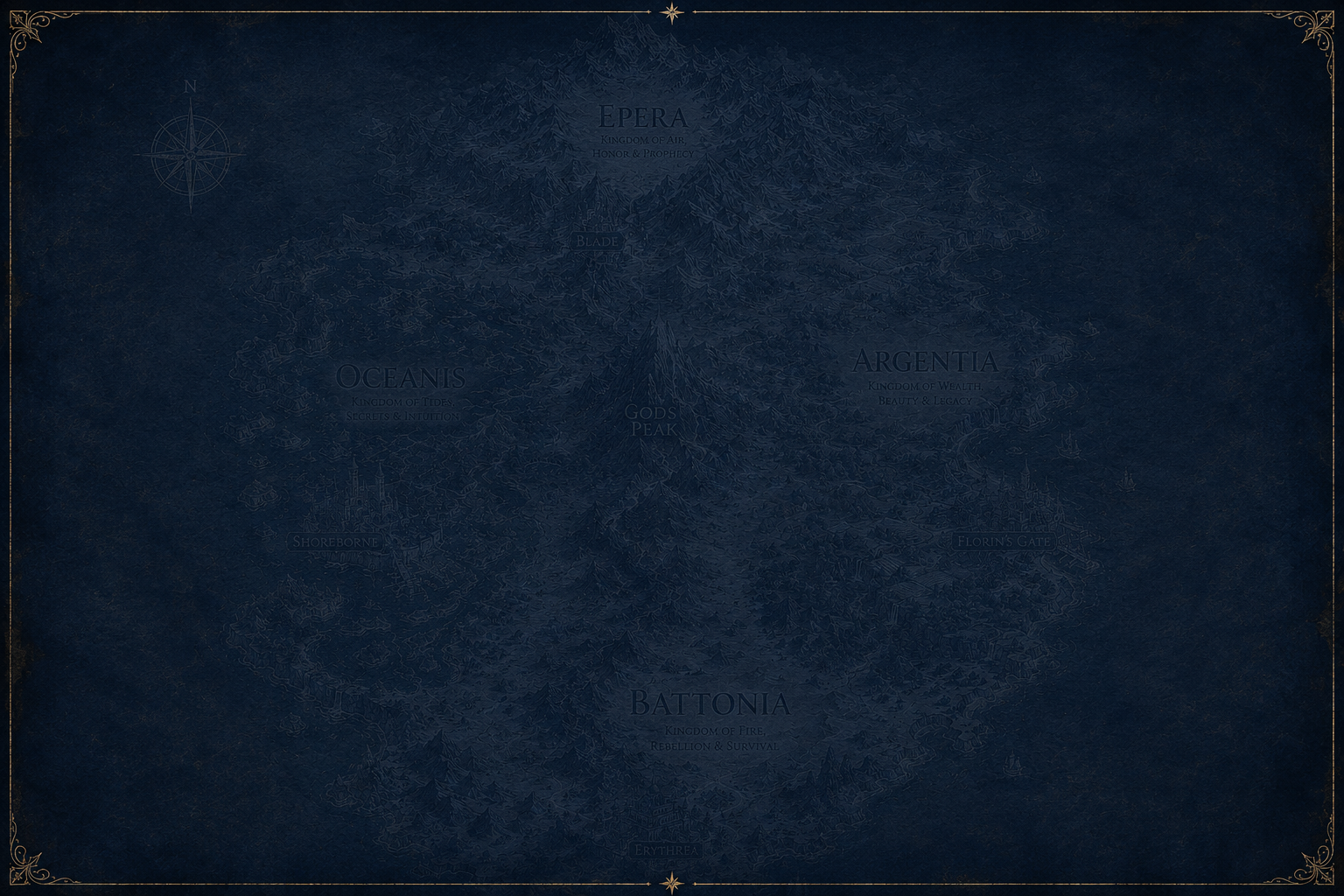
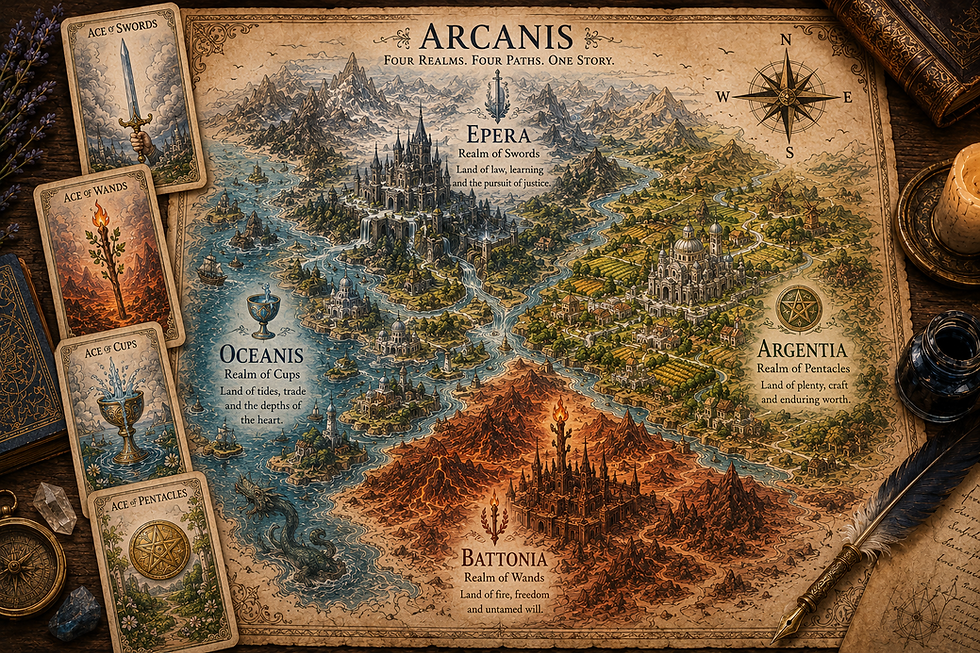
In my Way of the Wands series, the Emperor’s archetype takes centre stage in the desert kingdom of Battonia. The people of Battonia worship the Ember King, a deity who embodies the positive attributes of the Emperor: the flame of discipline that keeps wild fire from consuming everything, the boundary lines that allow passion and energy to be channelled productively. Yet in practice, Battonia is ruled not by the Ember King’s benevolent order, but by his human representative — the Magister.
And the Magister, like the reversed Emperor card, shows us what happens when authority curdles into authoritarianism.
The Upright Emperor: Structure, Protection, Boundaries
In its upright form, the Emperor card is powerful, reassuring, and deeply necessary. Imagine a desert landscape: wide, empty, full of both promise and danger. Without boundaries, without irrigation channels, without some kind of order, the desert becomes chaos. The Emperor provides the framework that makes life possible.
In tarot, the upright Emperor speaks of:
Structure: Rules and systems that hold society together.
Authority: Leadership rooted in wisdom and long-term vision.
Boundaries: The ability to say “this far, and no further.”
Protection: A fatherly instinct to safeguard those in one’s care.
When we draw the Emperor upright, we are asked to consider where we need structure in our lives. Are we flaring out in too many directions? Are we trying to do everything without a system to hold us steady? The Emperor steps in to say: “Build the foundation first. Create the walls. Protect the flame.”
For Battonia, this aspect of the Emperor is reflected in the Ember King — a divine presence who offers stability to a people whose lives are harsh, sun-scorched, and constantly threatened by scarcity. The Ember King’s festivals are vibrant, full of contests and challenges that remind Battonians passion is strongest when tempered by discipline. Upright, the Emperor is a figure of growth through boundaries.
The Reversed Emperor: Tyranny, Rigidity, Suppression
But the Emperor, like all cards, has a shadow.
Reversed, the Emperor stops being the wise father and becomes the tyrant. Instead of protecting, he dominates. Instead of setting healthy boundaries, he imposes harsh restrictions. Instead of order, he brings stagnation.
Key meanings of the reversed Emperor include:
Tyranny: Power wielded for personal gain rather than collective good.
Rigidity: Rules that choke life rather than nurture it.
Suppression: Crushing individuality in the name of order.
Fear of Chaos: A desperate clinging to control, even when it destroys creativity.
In Battonia, this is embodied by the Magister. While the Ember King represents fire as a sacred, life-giving force, the Magister demands obedience and conformity. Under his rule, the natural vibrancy of Battonian culture — its charisma, its competitive joy, its flamboyant festivals — is twisted into harsh discipline. The fire that should warm and inspire becomes the fire of surveillance, punishment, and fear.
This is the danger of the reversed Emperor: when rules cease to serve life and instead life is bent, painfully, to serve the rules.
Fire in Chains: Battonia’s Struggle
One of the most fascinating things about writing the Way of the Wands is exploring how fire itself becomes a metaphor for this tension between freedom and control. Fire is passion, energy, and creativity. But it also needs boundaries — a hearth, a torch, a lamp — otherwise it consumes everything.
In Battonia, flame magic depends on light. Sunlight fuels the power; candles and lamps offer pale substitutes. The Ember King teaches his people to respect the discipline of fire. But the Magister enforces this with iron-fisted zeal.
Imagine a child who loves to dance in the desert festivals, only to be scolded for stepping out of line. Imagine a gifted flame-caster who is told their sparks are too wild, too dangerous, unless sanctioned by the Magister’s authority. Imagine a whole people whose natural warmth is slowly suffocated beneath layers of control.
This is the reversed Emperor at work: a society where boundaries have stopped serving freedom and instead become walls of a prison.
The Emperor in Our Lives
It’s easy to point at fictional tyrants and see the reversed Emperor in them. Harder, but just as important, is to ask: Where does the reversed Emperor show up in me?
Do I sometimes cling to control when life feels chaotic, becoming rigid rather than resilient?
Do I impose rules on myself so strict that they choke joy?
Do I mistake discipline for self-punishment, forgetting that boundaries are meant to support, not destroy?
The Emperor reversed asks us to look at our relationship with authority — both external and internal. Sometimes it’s a boss, a system, or a government that has become oppressive. Sometimes it’s the voice inside our own head, telling us we must not step outside the line.
When upright, the Emperor is essential. He helps us focus, build, and protect what matters. But when reversed, he warns us that too much rigidity leads to lifelessness.
Upright vs. Reversed in Storytelling
As a storyteller, I find tarot’s duality endlessly inspiring. The Emperor isn’t just one thing. He’s both protector and tyrant, both order and oppression, depending on how he manifests. That tension is exactly what makes him fascinating to write.
In Way of the Wands, the Magister serves as a mirror of the reversed Emperor. He is the father-figure gone wrong, the authority twisted into abuse. His presence forces the characters — fiery, passionate Battonians — to wrestle with their own relationship to rules and freedom.
Domita, one of my central figures, is already skilled with fire, but under the Magister’s regime, her very nature is treated as dangerous. She must learn where true discipline lies: not in blind obedience, but in choosing her own boundaries, her own way to channel the flame.
This, too, is the lesson of the Emperor. We need structure, but not shackles. We need boundaries, but not prisons. We need protection, but not domination.
Living with the Emperor
When you encounter the Emperor in your own tarot readings, ask yourself:
Is this card upright, offering me guidance to create structure and stability?
Or is it reversed, warning me that I may be leaning into rigidity, fear, or tyranny?
Neither answer is “good” or “bad” — both are instructive. Upright, the Emperor calls you to step into authority, to protect and guide with wisdom. Reversed, he invites you to examine where authority has become unhealthy, and where freedom is being stifled.
In truth, both aspects live within us. The challenge is to balance them: to embrace structure without suffocating, to wield authority without crushing, to honor boundaries without building walls too high to climb.
Conclusion: The Emperor’s Fire
The Emperor is one of tarot’s most powerful archetypes because he forces us to reckon with power itself. How do we use it? How do we submit to it? How do we resist it?
In Battonia, the Ember King shows the beauty of the upright Emperor: boundaries that channel fire into festivals of joy, competitions of brilliance, and communities that thrive even in the desert. The Magister, however, reveals the danger of the reversed Emperor: fire as a weapon of fear, passion twisted into obedience, life narrowed to fit a single vision.
The Emperor asks each of us: What kind of authority will you embody? What boundaries will you set — and will they protect life, or imprison it?
Because in the end, the Emperor’s lesson is not about dominance. It’s about responsibility. To wield fire wisely. To honour freedom within a structure. And to remember that every boundary we set should be in service of life, not against it.


Comments