How a Deck of Cards Became the Architecture of an Epic Fantasy

In an earlier post, I told you how Tales from the Tarot began — with a question that followed me around for almost forty years.
What if the people inside the Court Cards were real?
That question became Arcanis. But it doesn't quite explain why the world took the shape it did.
Arcanis was never simply a setting for me. It was something I'd been glimpsing for years without quite recognising it — hiding in plain sight, waiting for me to notice.
I've studied the Rider–Waite deck for over forty-five years now, and like most readers, I fell for the major figures first — the Fool stepping off his cliff, Justice with her steady scales, the Hermit holding up his lantern. But it was always the people in the background who caught me. The farmer pausing mid-labour. The merchant striking his bargain. The family gathered under a rainbow of cups. The traveller bent under a burden that looks far too heavy for one pair of shoulders.
Those figures are grieving, choosing, working, loving, enduring — and the Minor Arcana doesn't explain any of it. It just shows it to you. One moment, caught mid-breath, hinting at a much larger life happening just outside the frame.
Forty-five years of reading tarot — and Lenormand, more recently — has quietly changed what I use the cards for. I read less for divination now and more as a kind of map of becoming. The questions the cards keep circling back to are the ones that actually matter to me: How do we carry loss? What does real responsibility look like? How do we wield power without being ruined by it? What does forgiveness actually cost?
Those questions interested me far more than predicting tomorrow ever did.
Then there were the Court Cards.
Unlike the numbered cards, they don't show you a moment — they show you a person. Or maybe a possibility. Their expressions never quite give the whole story away; there's always something held back in the posture, the tilt of the head, the set of the jaw. I'd sit with them and think: what do they see that I can't?
What would it actually feel like to live behind the eyes of the Queen of Swords? Or the Knight of Wands? What would they have carried, got wrong, had to learn the hard way, before they earned the right to be that card?
Those questions are the foundation everything else was built on. Not because I wanted to retell the tarot — I had no interest in that — but because I wanted to dig into the humanity underneath the symbolism.
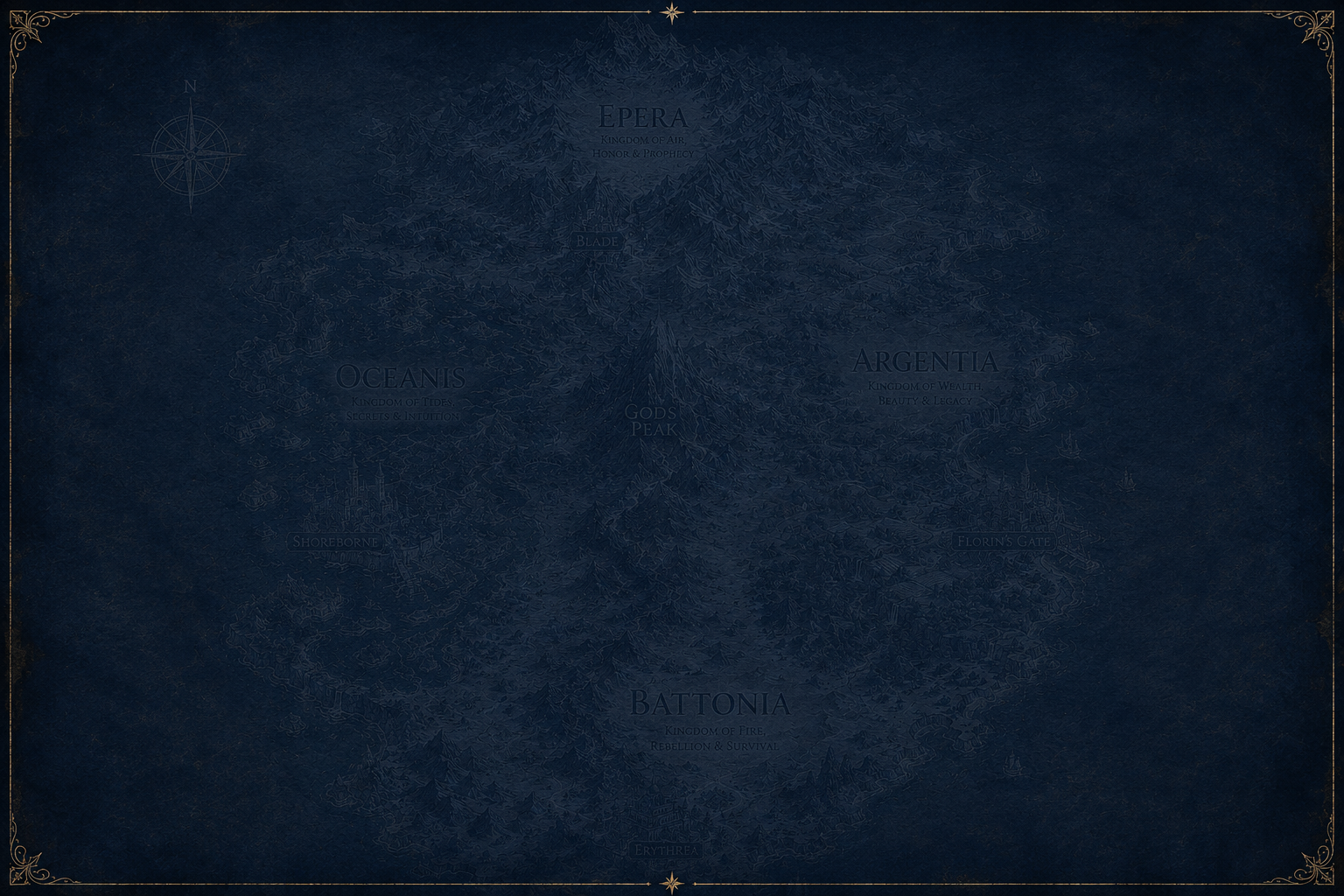
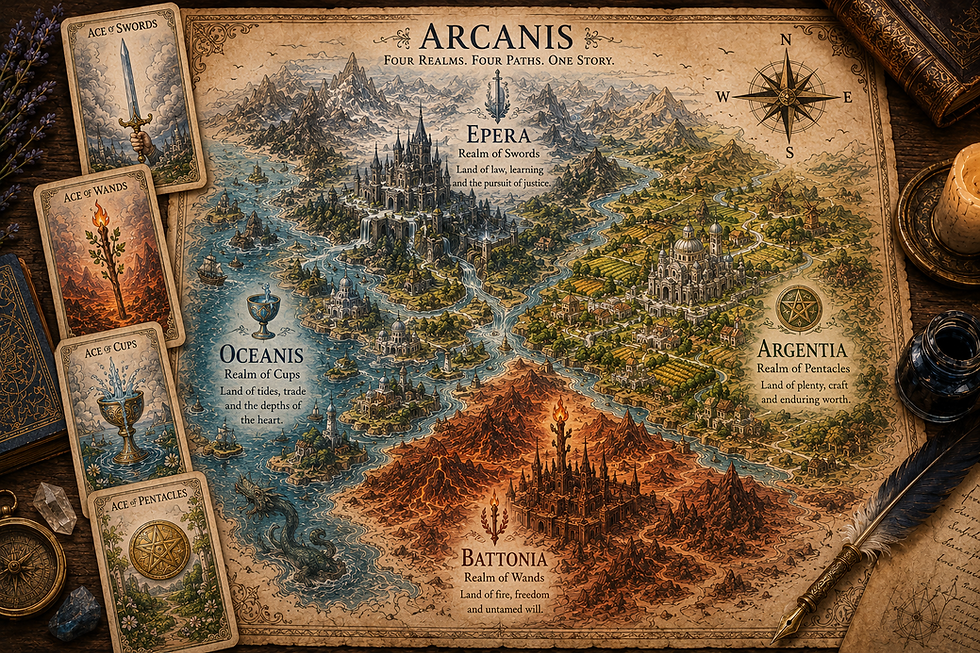
To me, Arcanis is the topography of the tarot made literal. Each kingdom is built from the essence of one suit — its landscape, its politics, its history, its magic, all of it grown out of that symbolic root. The people born there inherit the gifts of their homeland and its shadow side too, the same way every suit in the deck carries both.
So the stories never start with plot for me. They start with a question.
Saga of the Swords asks what happens when justice and mercy pull in opposite directions. Way of the Wands asks what freedom actually costs — and whether love itself can be an act of rebellion. Every series I write starts at the symbolic heart of its suit and asks what that idea would look like lived out by real people, ordinary and extraordinary both.
That's why writing in Arcanis has never once felt like invention. It feels like exploration. Every novel uncovers another corner of the continent I hadn't walked yet. Every character teaches me something about the cards I thought I already understood. Each book turns up a question I didn't know was hiding in the deck.
I think of Arcanis as a continent with its gates left open. Not because every answer is waiting there, but because every journey worth taking starts with curiosity rather than certainty.
Maybe that's the real reason this series keeps surprising me, book after book. I've lived with these cards for most of my life, and they're still finding new ways to ask me the same old questions — about courage, justice, grief, responsibility, and love.
Arcanis just gives those questions somewhere to walk.
It was always there. Waiting in the cards.
I only have the privilege of following where they lead — one story at a time.
If any of this has stirred something in you — if you've ever wondered what the citizens of Arcanis get up to when no one's watching — Arcanis has a door standing open for you.
Become a Citizen of Arcanis, and The Arcanis Chronicles will start turning up in your inbox once a month: the continent's paper of record, reporting on the four kingdoms with the seriousness they so rarely deserve.
Expect dispatches from wherever the trouble currently is, Little Bird's court gossip (unverified, unrepentant), a lonely hearts column that has done more damage than any war, a lost-and-found of questionable honesty, and the occasional notice that a throne, a temple post, or a rebellion needs staffing. Now and then, word arrives of a new book too — though the Chronicles has never let that get in the way of a good scandal.
Citizenship is free. So, generally, is the trouble it invites.
Become a Citizen of Arcanis → And meet Carlos Nepolas — a grieving fisherman of Oceanis, who has a story to tell you. If you'll just meet him after hours at the Mermaid Tavern and share a tankard... or two...


Comments